


Threads is an OCD center that uses spatial design to support therapy, awareness, and community interaction. Focused on contamination and checking OCD, the project integrates ERP-based environments, workshops, and shared spaces to help individuals gradually challenge compulsive behaviors while fostering understanding and support.
Research

Problem

Form exploration
The form of Threads is shaped by the way OCD thoughts evolve. It starts with scattered elements, representing intrusive and overwhelming thoughts. As they repeat and connect, they form continuous loops, mirroring compulsive patterns. These loops are then refined into clear, controlled boundaries, bringing a sense of order and stability. As the form develops, it becomes inhabitable, creating spaces that guide movement, reduce uncertainty, and support the therapeutic experience.

.jpg)
Materials Board
The material palette is designed to respond to contamination and checking OCD by reducing visual and sensory triggers while maintaining a controlled and predictable environment.
Low-reflective and non-porous surfaces support hygiene perception and minimize visual fixation, while soft and acoustic materials reduce sensory overload.
Frosted glass introduces diffused boundaries that limit unnecessary visual checking, and biophilic elements are applied in a controlled manner to support well-being while allowing gradual exposure within a structured setting.
Spaces
Guided. Controlled. Supportive.
The center is designed as a sequence of spaces that support different stages of experience, from initial entry to interaction, reflection, and therapeutic engagement. Each space is carefully structured to provide clarity, control, and a balanced level of stimulation, allowing users to navigate the environment in a way that feels predictable and manageable. Rather than overwhelming the user, the design introduces variation gradually, supporting both comfort and therapeutic progression.


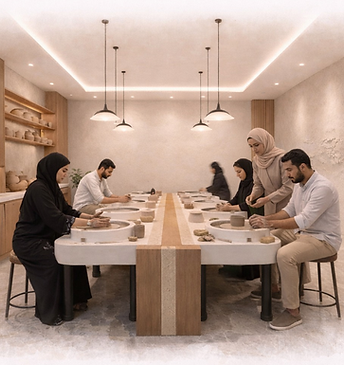


Family Counseling Room
A calm, supportive environment structured through clarity and spatial balance. The legible layout reduces uncertainty and reinforces a sense of control, while face-to-face seating encourages open communication. Generous spacing minimizes stress, allowing conversations to unfold in a comfortable and grounded setting.

Decompression Room
A controlled retreat space designed to reinforce personal boundaries and reduce perceived contamination risk. Continuous wall surfaces establish clear, legible limits, minimizing visual triggers associated with checking behaviors. Biophilic elements are carefully contained to maintain predictability and avoid sensory uncertainty, while a curved ceiling and indirect lighting soften the environment, eliminating harsh contrasts and supporting visual and emotional regulation.

Rendered Floor Plan – Spatial Organization
The floor plan organizes the center into a clear sequence of public, semi-private, and private zones. Spaces are arranged to support a gradual transition from open interaction to focused therapeutic environments, maintaining clarity, orientation, and controlled movement throughout.

Rendered Section – Spatial Experience
The section illustrates the relationship between spaces, highlighting variations in height, light, and openness. It emphasizes the transition from enclosed, controlled environments to more open and biophilic areas, supporting a gradual and manageable spatial experience.